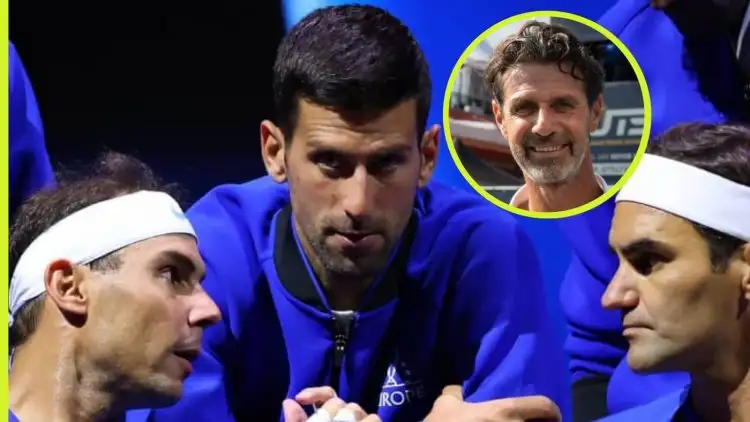
From Average to All-Time Great: The Unbelievable Rise of Novak Djokovic
In the world of men’s tennis, few stories are as remarkable—or as misunderstood—as that of Novak Djokovic. When the Serbian star first emerged on the ATP Tour, his game was, by many accounts, unremarkable. Lacking the jaw-dropping elegance of Roger Federer or the explosive intensity of Rafael Nadal, Djokovic’s early performances often flew under the radar. His strokes were solid but not flashy; his presence, promising but not dominant. And yet, here we are: in 2025, Djokovic stands with more Grand Slam titles than both Federer and Nadal, and has made a compelling case as the greatest player of all time.
So how did a player with what many called an “average” game reach such legendary heights?
The Underrated Foundations
When Djokovic turned pro in the early 2000s, the tennis world was already enthralled with the artistry of Federer and the brute force of Nadal. Djokovic lacked the effortless one-handed backhand and smooth movement of Federer, and he didn’t bring the same raw physicality or relentless topspin as Nadal. Critics saw him as solid across the board but without a defining weapon. His serve was decent, his forehand a bit mechanical, and his backhand—while consistent—wasn’t the kind to make highlight reels.
But Djokovic had something that didn’t always show up in stats or slow-motion replays: a deep, almost obsessive commitment to improvement.
Evolution Over Time
Djokovic’s game evolved continuously. He restructured his diet and training to achieve peak physical condition, famously adopting a gluten-free diet and investing heavily in recovery techniques. He built a bulletproof two-handed backhand, turned his return of serve into arguably the best in tennis history, and made his movement the gold standard on all surfaces—especially on hard courts.
While others relied heavily on one or two weapons, Djokovic built an all-court game without weaknesses. He became a master of attrition, breaking down opponents with consistency, depth, and mental resilience.
Mental Fortitude as a Weapon
Perhaps the most significant evolution came between the ears. Djokovic developed an almost zen-like composure on court, capable of surviving the most hostile crowds, the most daunting deficits, and the most legendary of rivals. Time and again, he clawed his way back from match points down, from injury scares, and from year-long slumps to reassert himself as the man to beat.
Federer and Nadal set the bar—no doubt about that. But Djokovic not only caught up, he surpassed them statistically in several key areas: most Grand Slam titles, most Masters 1000s, most weeks at No. 1, and winning records against both of his greatest rivals.
Legacy Reconsidered
Calling Djokovic’s early game “average” may have been fair at the time—but it also misses the bigger picture. His career is a testament to growth, adaptability, and relentless pursuit of greatness. Where others peaked and plateaued, Djokovic found new layers.
It’s that journey—from a solid pro to a historic titan—that makes Djokovic’s story so incredible. He didn’t start with the same natural flair, but through sheer will and evolution, he may have written the most compelling chapter in tennis history.
In the end, greatness isn’t always born—sometimes, it’s forged. And Novak Djokovic is living proof.